À la une › One on the field, one everywhere
One on the field, one everywhere
On June 15, 1974, in Munich, a 22-year-old striker named Emmanuel "Manno" Sanon broke past the Italian defense and beat Dino Zoff. Six minutes later, Italy equalized. Fifty-two years later, that one goal — not the two that followed — is what every Haitian over sixty can still describe second by second. The solo run. The Italian keeper beaten. The silence in the streets. Then the roar.
From that day on — for exactly fifty-two years — Haiti has not returned to a World Cup.
What that absence has cost us cannot be measured in FIFA rankings or sponsorships. It is measured in generations. Three generations of Haitians have never shared a single collective moment that cleared, without dispute, the borders of class, region, political party, and faith. Carnival stays regional, sometimes captured. Elections divide by construction. The moments of grief — January 12, 2010; Matthew in 2016; the massacres of recent years — have brought us together in pain, never in pride. For half a century, twelve million Haitians, on the island and across the diaspora, have had no shared object to turn our heads toward at the same moment.
On June 11, 2026, that changes.
This is not about positive thinking. It is not about the psychology of success. It is about something precise, observable, and old: when a people watches the same thing at the same moment, it becomes again — for a few hours, a few days, a few weeks — a people.
Anthropologists call it collective effervescence. Haitians say it more simply: lè nou ansanm. They are saying the same thing. And they are both saying that this moment — shared attention, breath held in common, the simultaneous roar from one end of a territory and a diaspora to the other — is itself a resource. Not a metaphor. A real resource, whose absence leaves a deficit, and whose presence leaves a mark.
That resource is something Haiti has been without since 1974.
The 2026 Grenadiers are not charged with winning the World Cup. No one is seriously asking them to. What they carry is rarer and more useful: for one month, they are the only object of attention that every Haitian woman and every Haitian man is looking at together.
The school director in Bel-Air and the tap-tap driver in Carrefour. The pastor in Gonaïves and the mambo in Souvenance. The electrician in Brockton and the home health aide in Montreal. The engineer in Miami and the law student in Pòtoprens. The grandmother in Jacmel and the grandson in Brooklyn who hasn't spoken Kreyòl to her in ten years. While the ball rolls, those twelve million people are watching the same thing. That is all. That is enormous.
No political campaign in the last fifty years has assembled that audience. No state program, no international NGO, no diaspora initiative has reached it. The Grenadiers do it without claiming to, simply by existing.
Win or lose, the dividend is the same.
If the team wins a match — especially the first, especially against a nation no one expected — there will be, in hundreds of streets in Pòtoprens, Cap-Haïtien, Les Cayes, Hinche, strangers embracing strangers. In apartments in Boston and Montreal, families who hadn't called since Christmas will call. It is measurable. It leaves a mark.
If the team loses — and the statistics are cruel for a nation returning after fifty-two years — there will be, in the same streets and the same apartments, a disappointment lived together. Shared disappointment, unlike isolated disappointment, is not a poison. It is mortar. The country of Manno Sanon knows something about this: we were eliminated in 1974 after three matches, and the goal against Italy still feeds us.
What counts is not the score. It is the fact of having watched, together.
During that month, a neighbor in Delmas who hadn't said good morning to the neighbor across the street since last year will cross the street to ask: "Ou wè gòl la?" A cousin in Cap-Haïtien whose family in Brockton hadn't called in two years will receive a call after the match. An employer and an employee, who speak only about work instructions, will share for ninety minutes the same anthem, the same flag, the same tension. Multiplied by twelve million.
That is what the Grenadiers give back to us: not a victory — a coordination.
For one month, Haiti becomes legible to herself again.
The tournament will end.
Somewhere in July, a team will lift the cup and it will not be ours. So what? What we will have felt during those weeks — that simultaneous presence to ourselves — does not need the cup to exist.
The feeling of being together does not need to end with the tournament.
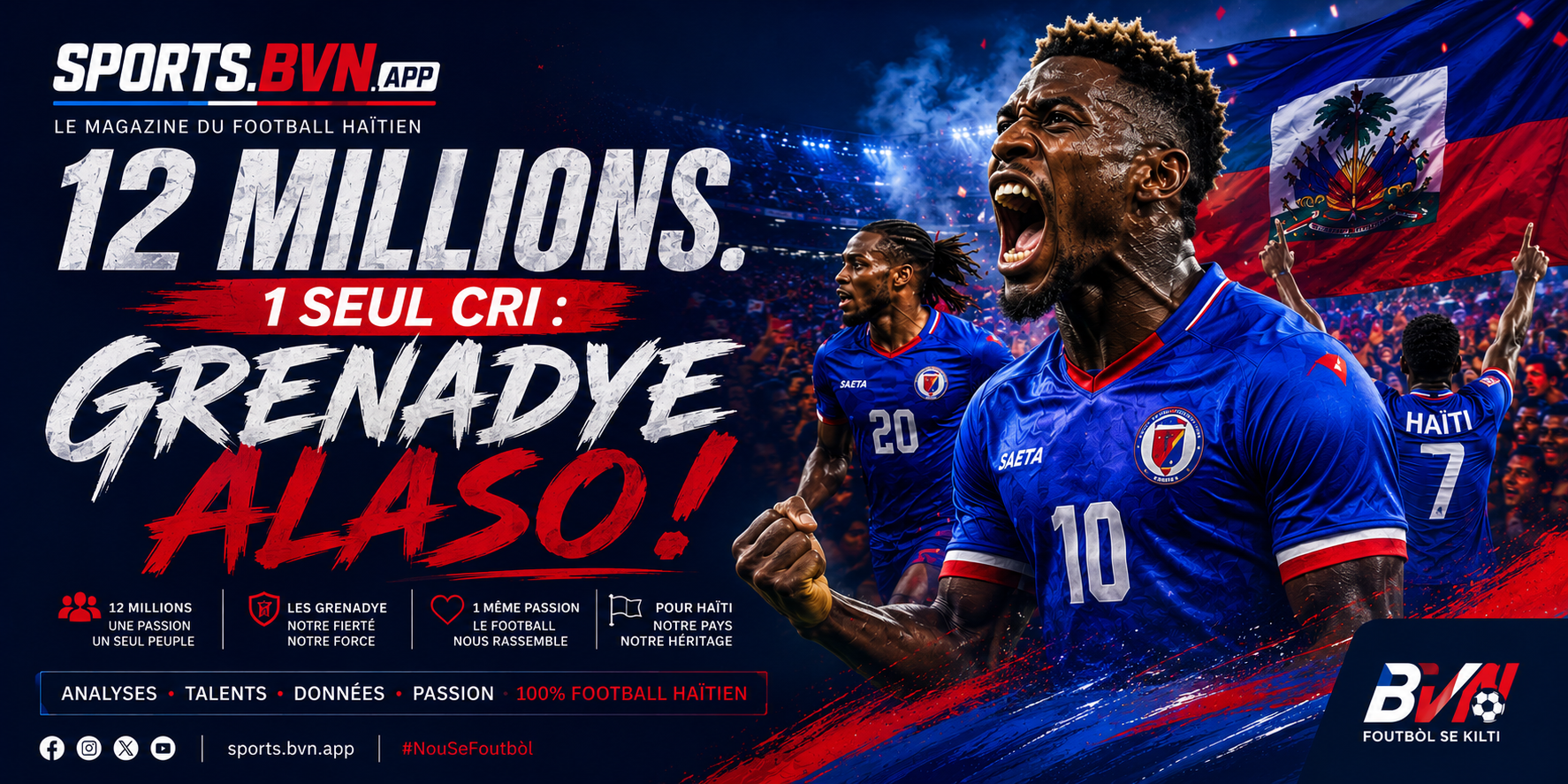
That is why sports.bvn.app exists. That is why we carry the anthem Grenadye Alaso, the image Nou Ansanm, and the phrase that sums it all up: yon sèl sou teren an, yon sèl tout kote.
Stay with us. Not only until the tournament ends. After.
Stay with us
Not only until the tournament ends. After. One email, in your language.
Email ou téléphone — au moins un. Vos infos restent privées, désinscription à tout moment.
